Feature of the week
December 4th Week, 2025
On Space Time Foam
Project by Tomas Saraceno
Links:
Project Page
Word count: 1,287 words
Reading time: ~ 5 minutes
When Gravity Becomes Playable: Saraceno's Six-Month Design Test
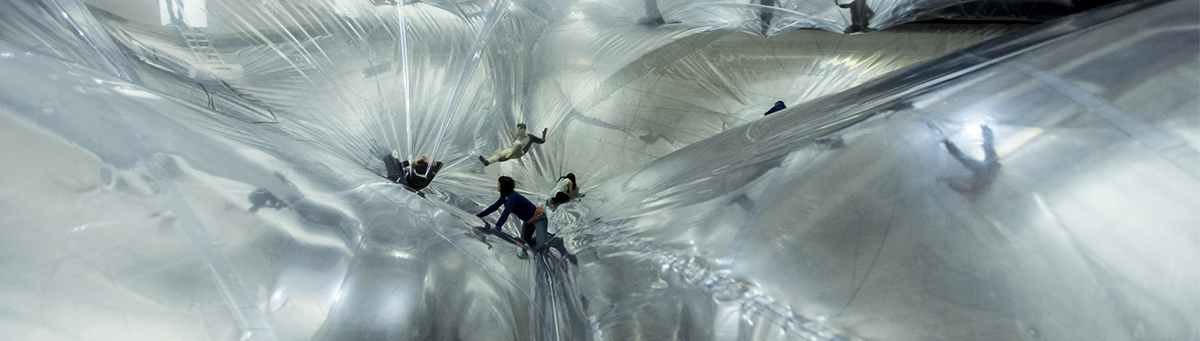
You step onto a nearly invisible membrane suspended 24 meters above ground in Milan. Your foot sinks. The surface deforms beneath your weight. A ripple travels across the film toward a stranger standing meters away. Your balance shifts. Their space reshapes. This is On Space Time Foam a structure that makes the invisible physics of weight, pressure, and interdependence suddenly tangible.
What you are stepping onto
From October 2012 to February 2013, Tomás Saraceno created this installation at Pirelli HangarBicocca in Milan.
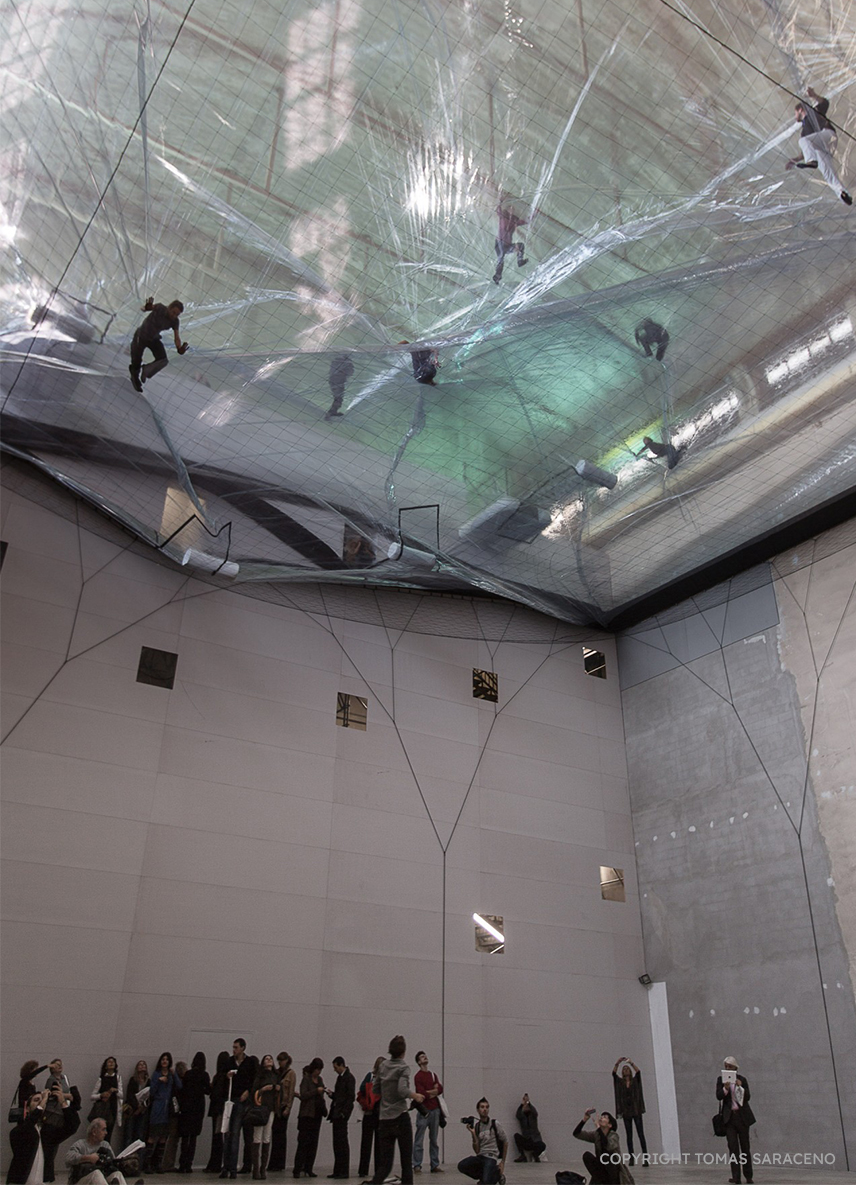
Three layers of transparent clear nylon film, pressed so tightly together there was almost no air gap between them. Each level maintained a different air pressure. The entire 1,200-square-meter structure hung suspended in an industrial space that once tested electrical turbines. Public access. Barefoot. No rules posted. Months of engineering and design work with a multidisciplinary team of architects and engineers, supported by Lindstrand Technologies, a company specializing in aerostatic materials used by the European Space Agency (ESA).
What emerged was a working model of interconnection.
![]()
![]()
Three layers of transparent clear nylon film, pressed so tightly together there was almost no air gap between them. Each level maintained a different air pressure. The entire 1,200-square-meter structure hung suspended in an industrial space that once tested electrical turbines. Public access. Barefoot. No rules posted. Months of engineering and design work with a multidisciplinary team of architects and engineers, supported by Lindstrand Technologies, a company specializing in aerostatic materials used by the European Space Agency (ESA).
What emerged was a working model of interconnection.
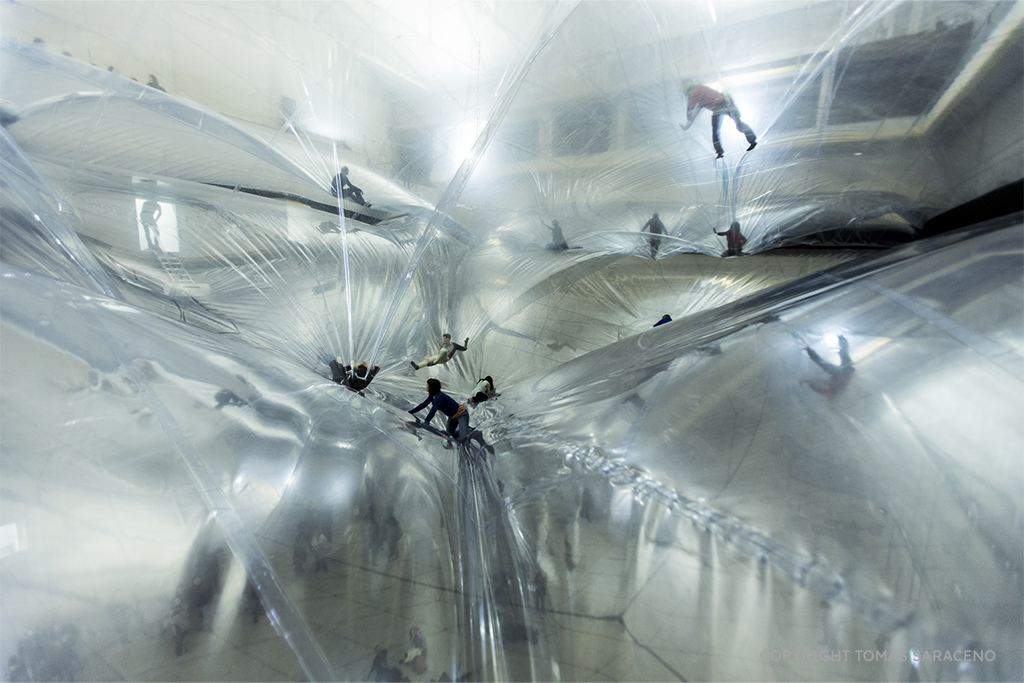

Tomas described it this way:
"While moving through the installation, it feels as if the space itself follows you, or as if it becomes a part of your body. You walk through it and while you do so you bend the space."
What the Installation Was Attempting
Saraceno's stated goal was direct: create a space where visitors would experience their relationship to others through physical presence, not explanation.
Every footstep modified the environment for everyone else. Your movement shifted others' balance. The membrane transformed based on collective presence.
He called it a "metaphor for how our interrelations affect the Earth and other universes."
He called it a "metaphor for how our interrelations affect the Earth and other universes."
The structure wasn't designed to prove anything scientifically. It was built to let visitors know interdependence through direct physical encounter.
How the Material Performed the Concept
The choice of transparent clear nylon revealed something essential about design thinking. This material doesn't explain causation - it displays it. When you watch your own weight deform the film beneath you, when you see ripples propagate outward affecting strangers, when you feel the ground shift as others cluster nearby, the connection between action and consequence becomes undeniable.
There was no need for interpretation. The membrane itself demonstrated how weight and movement reshape space around you.
There was no need for interpretation. The membrane itself demonstrated how weight and movement reshape space around you.
The Visitor Experience: What Actually Happened
"There is this kind of codependency," Saraceno noted, "the people which enter in the lower layer and the layers on the top...completely destabilize and work because one moment people are on one layer and then there are other two layers."
Saraceno documented the spatial dynamics that emerged. When visitors entered, he explained, immediate feedback loops created behavior without instruction. Opening doors between levels produced dramatic pressure changes. "When you open one door and the second door, a big flow of air will come...your hair kind of turns around and starts to move," Saraceno described. Visitors felt the air pressure shift, understanding viscerally that they were affecting the entire system.
The most revealing dynamic: clustering. When people stood too close together, their combined weight sank the membrane so deeply that escape became physically difficult.
![]()
The most revealing dynamic: clustering. When people stood too close together, their combined weight sank the membrane so deeply that escape became physically difficult.
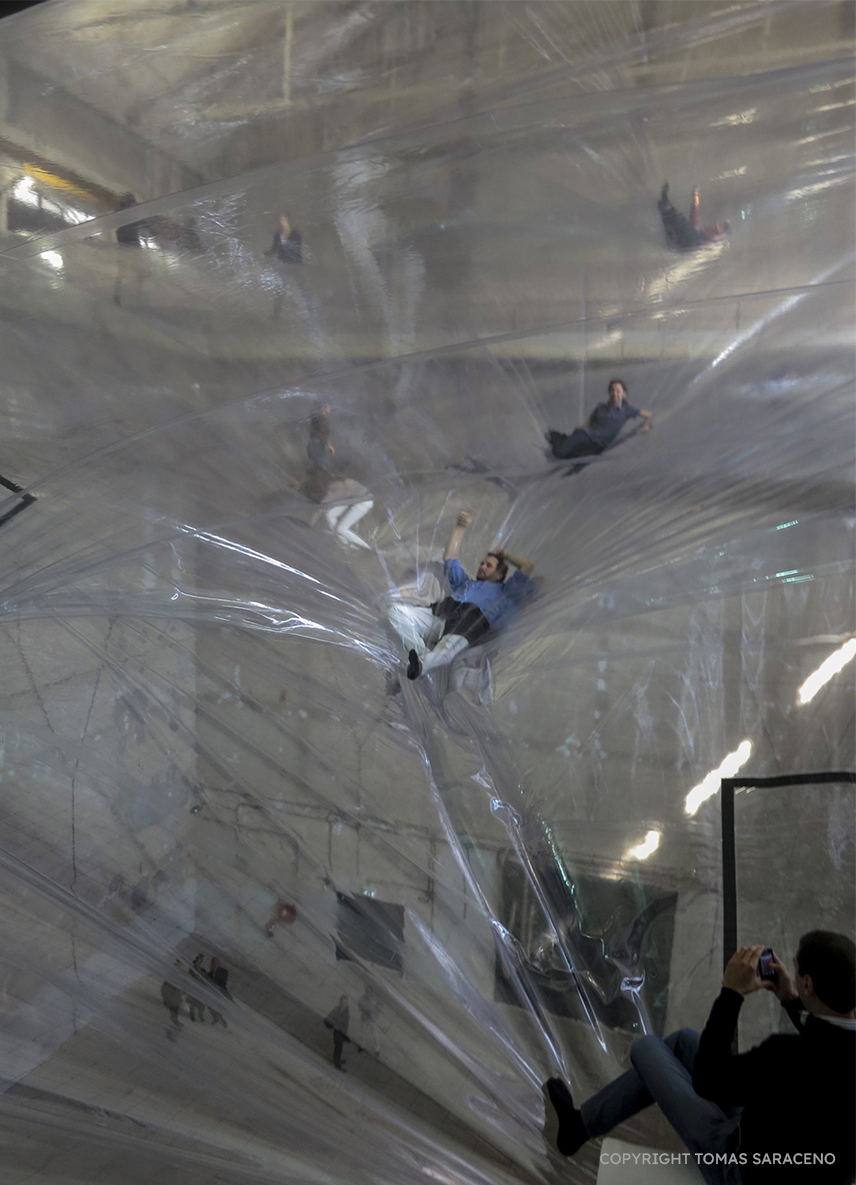
Visitors naturally dispersed. They found rhythm without being told. They coordinated their movement to maintain stability.
The installation also created what Saraceno called a "butterfly effect" - one person's small movement produced ripples that reached and affected everyone else on that level. The spatial layout made isolation impossible. Every action had collective consequence.
![]()
The installation also created what Saraceno called a "butterfly effect" - one person's small movement produced ripples that reached and affected everyone else on that level. The spatial layout made isolation impossible. Every action had collective consequence.

What Remained Experimental
The installation was explicitly framed as research in progress, not as proof of anything permanent. Saraceno himself acknowledged the limits of what a six-month temporary installation could reveal. During his later residency at MIT's Center for Art, Science & Technology (CAST), he discussed translating the concept into a floating biosphere above the Maldives Islands-a vision to address climate-vulnerable island nations.
The installation couldn't test what happens when people live in transparent pneumatic structures long-term. It couldn't answer questions about psychological comfort in transparent enclosures, emergency protocols if pressure systems fail, or lifecycle environmental costs of replacing degraded nylon. It was a moment of investigation, not a proven solution.
"A lot of scientists regard the biosphere experiment as an urgent need since our habitat is very complex and not well understood. Those reduced scale models often fail due to our technocratic perspective of living systems and our predictions about them." He added simply: "We don't know yet what it means."
What we can learn about Design Practice from this project
The installation revealed several things about how to design spatial experiences:

Engineer the environment to make certain behaviors inevitable. No signs told visitors "don't cluster." No staff monitored behavior. Instead, the physical properties of the membrane made clustering increasingly uncomfortable. Visitors self-organized within minutes. This is more reliable than direction.
- Temporary work can reveal real information
- Acknowledge what you don't know.
- Material choice shapes what visitors can understand.
The questions worth asking now:
- Does this approach to material and environment change how you think about designing for understanding?
- What would happen if you engineered your own projects so the environment itself taught what you were trying to communicate?
3. What would you need to know before claiming your prototype proves something at scale?
The Integrity of Experimental Work
On Space Time Foam succeeded at what it attempted: making physical interdependence tangible through direct experience. It revealed patterns in how people self-organize under constraint. It demonstrated how material choices can communicate concepts more effectively than explanation.
It also remained honest about its limits. Temporary. Unproven at scale. A moment of investigation, not a finished answer.
That honesty - about what the work does and what it doesn't - distinguishes genuinely experimental design from speculative claims dressed in research language.
Sources & Credits (Verified):
- Saraceno, Tomás. "On Space Time Foam: a Conversation @HangarBicocca." YouTube video, November 27, 2012.
- ArchDaily. "'On Space Time Foam' Exhibition / Studio Tomas Saraceno." November 2012.
- Artist statement and interviews from Studio Tomás Saraceno regarding experimental work and biosphere research.
- Evolo Magazine. "Walking on Clouds: On Space Time Foam by Tomas Saraceno." September 2013.
Additional sources referenced:
- Pirelli HangarBicocca Exhibition Documentation (2012-2013)
- Google Arts & Culture: Tomás Saraceno. On Space Time Foam
- MIT Center for Art, Science & Technology (CAST) - Tomás Saraceno Residency (2012-2014)
All quotes from Tomás Saraceno are drawn from documented interviews, artist statements, and public video documentation. Photography credits © Tomás Saraceno and Pirelli HangarBicocca. Rights reserved.